
At K
AFRICA MONTH 2026
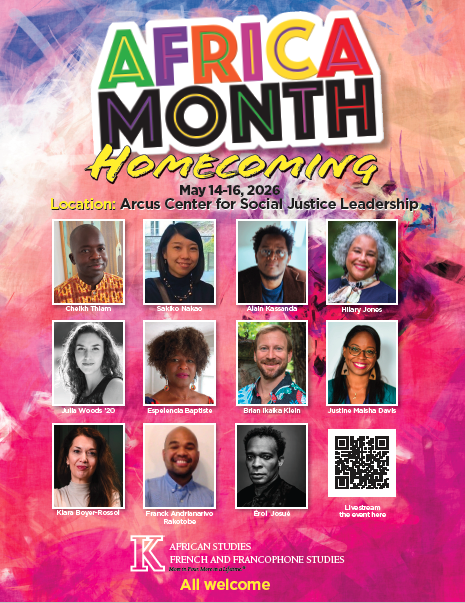
May 14–16, 2026 | Arcus Center for Social Justice Leadership
The African Studies Program at Kalamazoo College is excited to announce the second edition of Africa Month.
Africa Month is an annual celebration of Africans and African descendants that centers their ideas, artistry, and scholarship. Through lectures, performances, workshops, and cultural events, it brings together faculty, staff, students, and community members to engage key questions about Africa and its diasporas.
May holds particular significance for Pan-African histories and futures. It marks the founding of the Organization of African Unity and coincides with Haitian Flag Day. Africa Month is rooted in a long history of Black internationalism, resistance, and imagination.
The 2026 theme, Homecoming, explores how movement across land, time, and memory shapes African worlds and their diasporas. It asks what it means to return in the context of colonial histories, displacement, and changing forms of belonging.
The program brings together scholars, artists, filmmakers, and performers to engage questions of return, restitution, migration, and knowledge production. It also invites reflection on study abroad as an intellectual and lived experience.
Livestream here
Register for the event here
Program Highlights
- Panels on Pan-Africanism, diaspora, belonging, and restitution
- Film screening and conversation
- Intergenerational roundtable on study abroad
- Music, dance, and community events
- Haitian Flag Day celebration
Full Program
Thursday May 14
4:30 PM | Welcome
5:00–6:30 PM | Panel I: The Homes of Pan-Africanism
Speakers
Cheikh A. Thiam (Amherst College) – Legacies of Fanon
(Presented as part of the Fanon Centennial and co-sponsored by the Department of Philosophy).
Sakiko Nakao (University of Tokyo) – Imagining the African Community and Drawing Its National Boundaries: Solidarity and Exclusion at the Intersection of Pan-Africanism and Nationalism
Moderator: Manfa Sanogo (Kalamazoo College)
6:30–7:15 PM | Reception
7:15–9:15 PM | Film Screening & Conversation
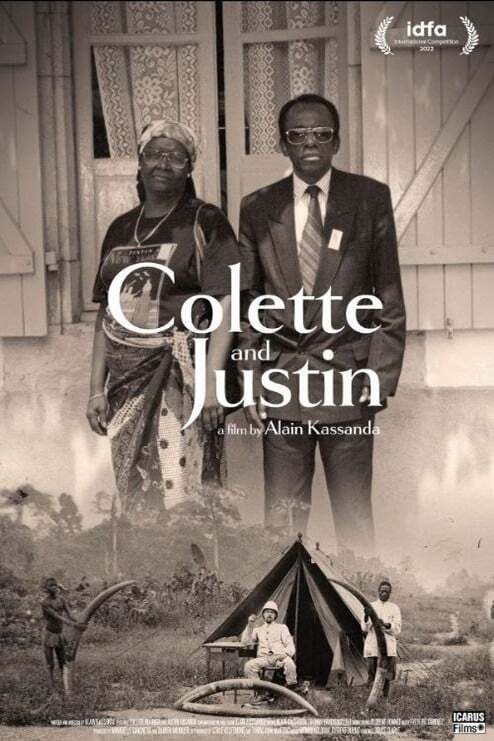
Screening of Colette et Justin, directed by Alain Kassanda, followed by a conversation with Babli Sinha and Jaakan Page-Wood (Kalamazoo College)
Friday May 15
4:30–6:30 PM | Panel II: Study Abroad as Epistemic Journeys: An Intergenerational Roundtable Discussion
Speakers
Hilary Jones (University of Kentucky) – From Kalamazoo to Senegal: Study Abroad as a Pathway to a Life in African Studies
Julia Woods (New York University; Kalamazoo College alumna) – Study Abroad as Exchange and Transformation: The Senegal–Kalamazoo Connection
Abosede Odukoya (Center for International Programs, Kalamazoo College) Lizbeth Mendoza Pineda (Center for International Programs, Kalamazoo College)
Tony Nelson (CET Academic Programs)
Sa’Niyah Bedell (Kalamazoo College)
Kennedy Campbell (Kalamazoo College)
Moderator: Koffi Nomedji (Kalamazoo College)
(Refreshments for the roundtable are provided by the Center for International Programs)
7:00–7:30 PM | Dinner & Music
7:30–11:00 PM | Dance & Games with Kalamazoo College Student Associations
(Sponsored by the Office of Student Involvement)
Saturday May 16
10:00 AM–12:00 PM | Panel III: Where Is Home?
Speakers
Espelencia Baptiste (Kalamazoo College) – Finding Home When You Can’t Go Home: How Haitians Complicate the Diasporic Return Narrative
Brian Klein (University of Michigan–Ann Arbor) – Miners’ Cultivation of Belonging in Betsiaka (Madagascar)
Justine Davis (University of Michigan–Ann Arbor) – Liberia and Côte d’Ivoire: Acceptance or Rejection of Dual Citizenship Policies and Perceptions of Loyalty
Moderator: Francisco Villegas (Kalamazoo College)
12:00–2:00 PM | Lunch & Artistic Break
2:30–4:30 PM | Panel IV: Restitution / Repatriation
Speakers
Klara Boyer-Rossol (IRD, France) – The Restitution of Human Remains and Plaster Casts to Madagascar, Mauritius, and La Réunion
Franck Andrianarivo Rakotobe (American University of Paris) – Textual Famadihana: Returning Bones in Contemporary Franco-Malagasy Narratives
Moderator: Dominique Somda (Kalamazoo College)
5:00–7:00 PM | Haitian Flag Day Celebration
Featuring Érol Josué (Institute of Ethnography, Haiti), Introduced by Espelencia Baptiste (Kalamazoo College)
Community celebration with food and music
FANON CENTENNIAL (2025-2026)
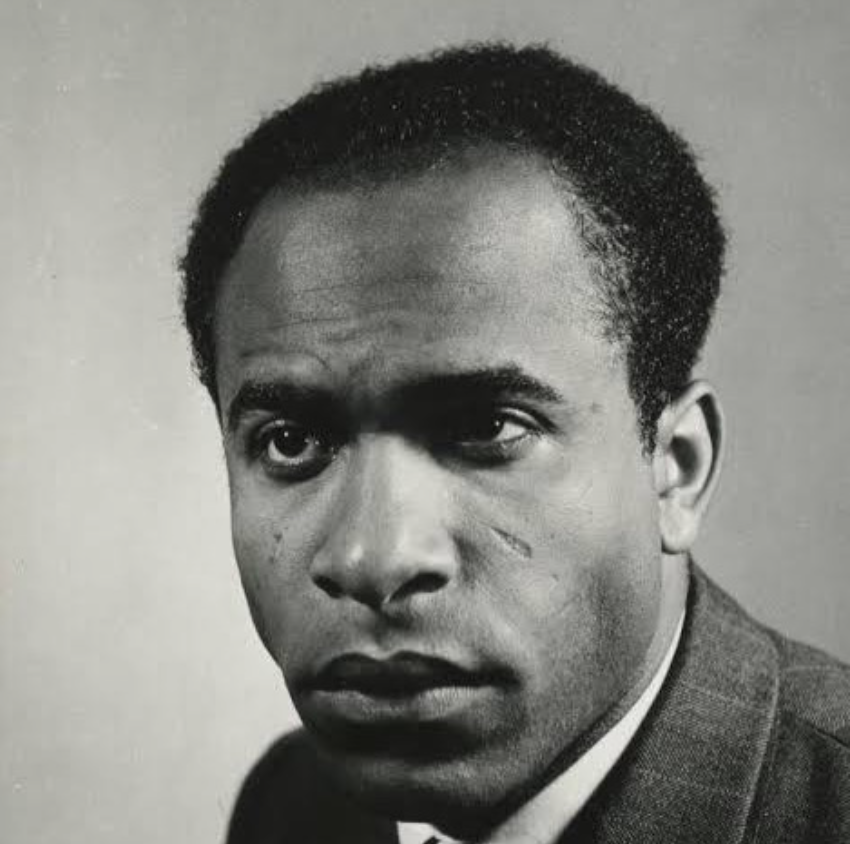
Psychiatrist. Philosopher. Revolutionary writer.
Born in 1925 in Martinique, Frantz Fanon exposed the psychological scars of colonialism in works such as Black Skin, White Masks and The Wretched of the Earth. His insights on race, violence, identity, and liberation continue to shape debates in psychology, literature, politics, and beyond.
Fanon trained in medicine in France, served as a psychiatrist in colonial Algeria, and ultimately joined the Algerian National Liberation Front. He died in 1961 at just 36 years old—but his influence remains profound.
At K College, and especially within African Studies, we mark his centenary this year, beginning with a film cycle.
Find a starter bibliography here.
Concerning Violence Screening Launches Centennial
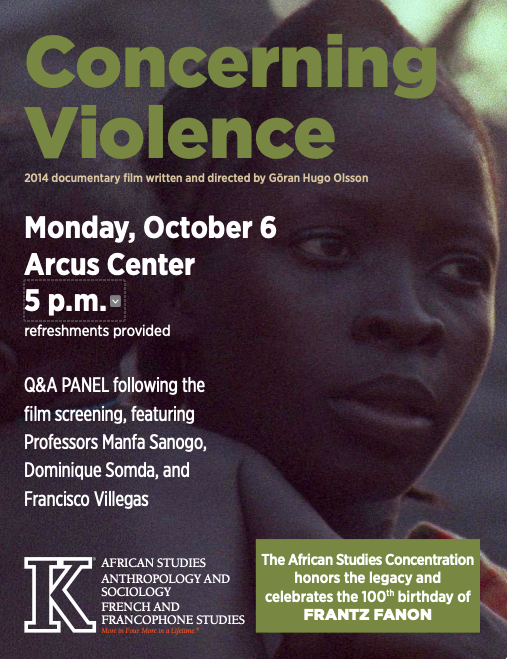
Join us as we launch a year-long celebration of Frantz Fanon’s centennial with a screening of the acclaimed documentary Concerning Violence on Monday, October 6, at 5:00 p.m. at the Arcus Center. Frantz Fanon—psychiatrist, philosopher, and revolutionary writer—was born in 1925 in Martinique.
Through seminal works such as Black Skin, White Masks and The Wretched of the Earth, he exposed the psychological wounds of colonialism and offered enduring insights on race, violence, identity, and liberation that remain profoundly relevant today. The 2014 film Concerning Violence, directed by Göran Hugo Olsson and narrated by Lauryn Hill, brings to life Fanon’s powerful essay “Concerning Violence” from The Wretched of the Earth, weaving together archival footage and Fanon’s revolutionary analysis of decolonization.
Following the screening, we’ll continue with a Q&A discussion featuring Profs. Francisco Villegas, Manfa Sanogo, and Dominique Somda as we reflect together on Fanon’s enduring influence and contemporary relevance. We look forward to beginning this centennial celebration in conversation with you.
Film Screening: Fanon, Yesterday and Today
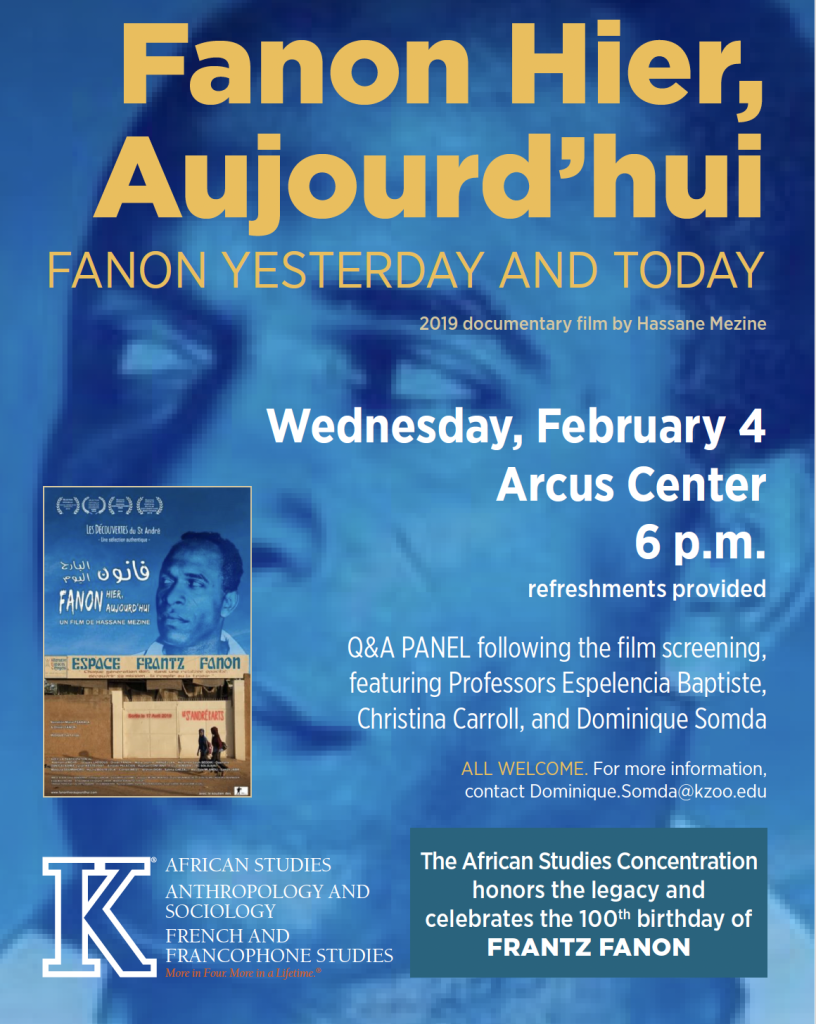
Join us for a screening of Hassane Mezine’s 2019 documentary, which traces Fanon’s influence from African independence movements of the 1960s to contemporary struggles for decolonization and racial justice across the African diaspora.
📅 Monday, February 4, 2026 | ⏰ 6:00 PM | 📍 Arcus Center
Free admission | Refreshments provided
Audience Q&A with Faculty
After the film, faculty from Kalamazoo College will lead a conversation with the audience about Fanon’s continuing relevance:
- Professor Espelencia Baptiste
- Professor Christina Carroll
- Professor Dominique Somda
Audience questions and discussion are encouraged as we explore Fanon’s insights into colonial violence, cultural identity, and revolutionary consciousness in contemporary African and diasporic contexts.
AFRICA MONTH 2025
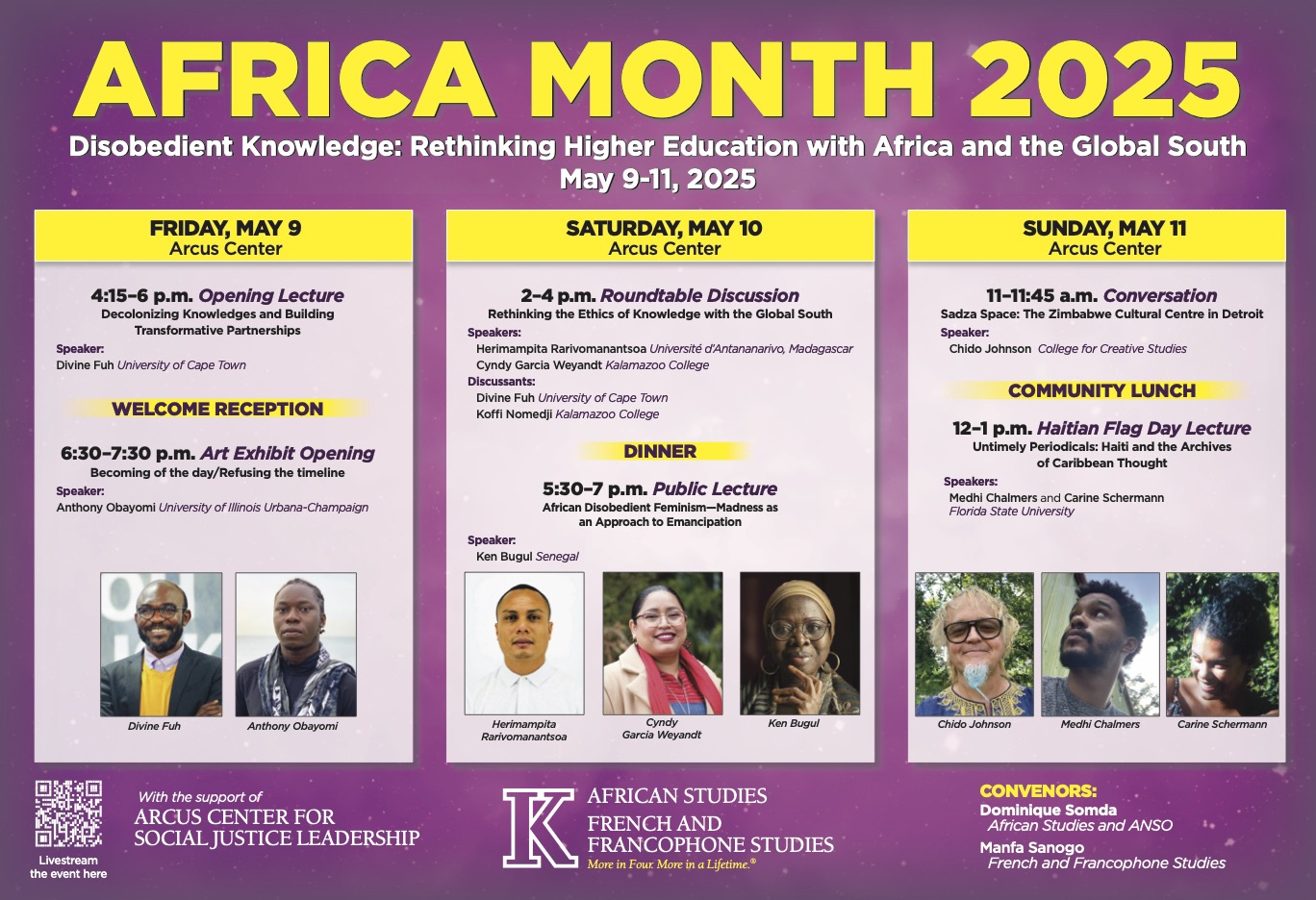
Disobedient Knowledge: Rethinking Higher Education with Africa and the Global South
We are thrilled to announce Africa Month 2025, a vibrant celebration that will mark the relaunch of the African Studies Program at Kalamazoo College!
This gathering is organized alongside the French Department and with the participation of many other dedicated colleagues from various departments.
Convenors: Dominique Somda (African Studies & AnSo) ; Manfa Sanogo (French &Francophone Studies)
🎉 Key Dates: May 9–11, 2025
The celebration will feature a series of thought-provoking events, bringing together students, faculty, staff, and the broader community. These include public lectures, workshops, and discussions centered on Southern Theories, non-Western epistemologies, and rethinking international partnerships.
Key Events
- Opening Lecture: Decolonizing Knowledges and Building Transformative Partnerships
Speaker: Divine Fuh (University of Cape Town) | May 9th, : 4:15 PM – Arcus Center - Art Exhibit Opening: Becoming of the Day |Refusing the timeline
Speaker: Anthony Obayomi (University of Illinois-Urbana-Champaign) | May 9th, 6 PM – Arcus Center - Workshop: Disobedient Pedagogies in Liberal Arts Education
For registered faculty and staff | May 10th, 9 AM – Arcus Center - Roundtable Discussion: Rethinking the Ethics of Knowledge with the Global South
Speakers: Herimampita Rarivomanantsoa (University of Antananarivo, Madagascar) & Cyndy Garcia Weyandt (Kalamazoo College) | May 10th, 2 PM – Arcus Center - Public Lecture: African Disobedient Feminism – Madness as an Approach to Emancipation
Speaker: Ken Bugul (Senegal) | May 10th, 5:30–7:00 PM – Arcus Center - Haitian Flag Day Lecture: Untimely Periodicals: Haiti and the Archives of Caribbean Thought
Speakers: Medhi Chalmers & Carine Schermann (Florida State University) | May 11th, 12 PM – Arcus Center - Community Lunch | May 11th, 12 PM – Arcus Center
Stay tuned for more updates and be part of this transformative conversation!
#AfricaMonth2025 #DisobedientKnowledge #KalamazooCollege #AfricanStudies #FrenchDepartment
Thinking Africa Lectures Series
Denis Regnier : Reimagining Medical Education in Rural Africa
Tuesday, February 18, 2025, from 4:15 PM to 5:30 PM in the Olmsted, Mandelle Hall.
About the Lecture
Reimagining Medical Education and Healthcare in Rural Africa: Insights from the University of Global Health Equity, Rwanda
In this talk, Denis Regnier explores the innovative approaches to medical education and healthcare delivery pioneered by the University of Global Health Equity (UGHE) in Rwanda. Focused on transforming health systems in rural Africa, UGHE’s model integrates social medicine, equity, and community engagement to train the next generation of health professionals. Drawing on his experiences as Head of Humanities and Social Sciences and Lead Faculty for Global Health Equity and Social Medicine, Regnier will discuss how UGHE reimagines medical education to address structural determinants of health while ensuring that marginalized communities are at the center of healthcare design and delivery. This presentation provides insights into the challenges and opportunities of implementing equitable healthcare in resource-limited settings and highlights the transformative potential of a socially grounded medical training.

About the Speaker
Denis Regnier is an anthropologist and the Lead Faculty for Global Health Equity and Social Medicine and an Assistant Professor at the University of Global Health Equity (UGHE) in Rwanda. From 2020 to 2024, Regnier served as the Head of Humanities and Social Sciences at UGHE, where he led initiatives integrating the social sciences and medical humanities into global health education. His work centers on the intersections of inequality, health, global health delivery, and social justice, with a particular focus on rural and underserved communities. Regnier has extensive research and teaching experience in Madagascar and French Polynesia. He is the author of Slavery and Essentialism in Madagascar: Ethnography, History, Cognition (Routledge, 2021) and co-editor of Family Violence and Social Change in the Pacific Islands (Routledge, 2023) and Tensions et Modernités dans le Pacifique Insulaire: Relations Postcoloniales et Conflits Épistémiques (Maison des Sciences de l’Homme du Pacifique, forthcoming). With a strong background in interdisciplinary pedagogy and field-based research, Regnier’s contribution to medical education seeks to better address the structural determinants of health. His current scholarship and teaching emphasize community-centered approaches and the role of social science in advancing health equity.
Seeing Africa Film Series
Coconut Head Generation by Alain Kassanda (2023, 89 min; France, Nigeria)
Film Screening & Director Q&A- January 25, 2025 (Dewing Hall, 103)

About the Film
At Ibadan, Nigeria’s oldest university, students transform their Thursday Film Series into a vibrant space for dialogue and debate, even in a country where dissent is often met with punishment. Their screenings of works by John Akomfrah, Jean-Marie Teno, Med Hondo, and others serve as springboards for compelling discussions on corruption, gender roles, LGBTQ+ rights, colonialism, and more.
The film captures the students’ daily lives—playing soccer, cooking instant noodles, and bonding—while also spotlighting their pivotal role in nationwide protests against police brutality. These young Nigerians face systemic challenges like frequent blackouts, overcrowding, and consequences for standing up for their beliefs, proving they are anything but the “coconut heads” older generations dismiss them as.